အမျိုးအစားများ
အမျိုးအစားများ

How Do You Choose Between Air Insulated Busbar Trunking and Compact Busbar Trunking?

The project drawings are on the table. The transformer rating is confirmed. The shaft dimensions are locked in. And someone still needs to sign off on which busbar trunking system actually goes into the building.
Jul 4th,2026 10 ရှုခင်းများ

The project drawings are on the table. The transformer rating is confirmed. The shaft dimensions are locked in. And someone still needs to sign off on which busbar trunking system actually goes into the building. This is the moment where most online resources fail engineers — they stop at definitions, leaving the real decision entirely unaddressed.

At ZHERUTONG, we manufacture both air insulated busbar trunking and compact (sandwich) busbar trunking, and we field this exact comparison question constantly from electrical engineers, MEP consultants, and procurement specialists working on factories, high-rise commercial towers, logistics warehouses, and data center fit-outs. The guidance in this article comes from production-floor and project-deployment reality — not catalog language.

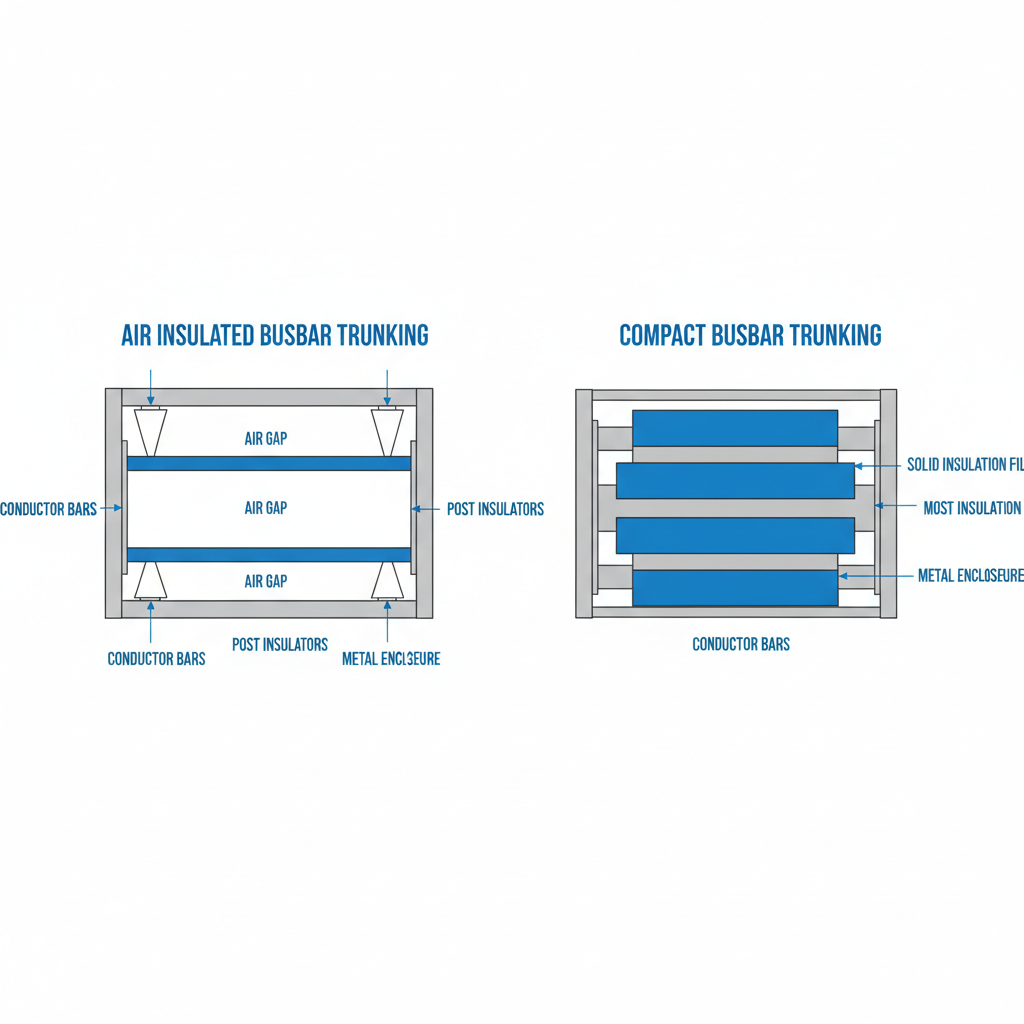
These are not simply two product variants. They represent genuinely different engineering philosophies. Air insulated busbar trunking uses physical air clearance as its primary insulating medium, with conductors separated by deliberate gaps maintained through post insulators or insulation blocks. Compact busbar trunking eliminates that gap entirely, wrapping conductors in solid insulation film and pressing them into a tight laminated stack. That single structural difference cascades into every downstream decision: current range, thermal behavior, installation footprint, environmental tolerance, and long-term cost. Understanding where that cascade leads is how you make the right call.

What Makes These Two Systems Structurally Different?

The core difference is not just insulation material — it is the presence or absence of an air gap between conductors, and that single design choice determines nearly everything else about how each system performs, installs, and ages.

In an air insulated busbar trunking system, copper or aluminum conductors are physically separated from each other and from the enclosure by deliberate air clearances. The conductors themselves are typically wrapped with polyester insulation film for supplementary protection, but the primary insulating medium between phases is air. Flame-retardant insulation blocks or post insulators maintain the required electrical clearance and creepage distances at defined intervals along the run. The enclosure must be large enough to accommodate those clearances — which is why air insulated housings are visibly wider and taller than compact equivalents at the same ampacity rating.

In a compact busbar trunking system, conductors are individually wrapped in Class B or Class F polyester or epoxy insulation film, then pressed together into a laminated sandwich with no air gap between them. The entire conductor assembly sits inside a much smaller metal enclosure. For a 1600A run, the cross-section of a compact housing from our RT series is typically 30–40% narrower than the equivalent air insulated housing — a difference that becomes critical in congested shaft designs.

Why does air insulated still exist at high current ratings? Because maintaining air clearance at 2500A to 6300A is physically manageable in large industrial spaces, and the alternative — solid insulation at extreme amperages — creates a thermal management problem that solid materials alone cannot easily solve. Why does compact dominate mid-range ampacity? Because eliminating the air gap reduces inductive reactance between conductors, which directly lowers voltage drop over long distribution runs. That is a measurable operational advantage, not a marketing claim.

One clarification worth making: "compact air insulated" hybrid variants exist in the market, occupying a middle ground. These should not be confused with either pure type. When specifying, confirm explicitly whether you are looking at a true sandwich construction or a reduced-clearance air insulated design.

How Do Current Range and Thermal Performance Compare?

Air insulated busbar trunking holds a genuine advantage at very high current ratings — particularly above 3200A — because natural convection within the air gap actively assists heat dissipation in ways that solid insulation cannot replicate without engineered ventilation.

The thermal physics here are worth understanding in detail, because this is the section most engineers cannot find clearly answered elsewhere.

In an air insulated system, the air gap between conductors functions as a passive convection channel. Heat generated by conductor resistance rises naturally, circulates within the enclosure, and dissipates through the housing walls. This is why air insulated systems can reach 6300A without forced cooling — the physics work in their favor at extreme ratings. The ZHERUTONG RT-CKX8 reaches this rating within IEC 61439-6 temperature rise limits precisely because the enclosure geometry is designed to maximize this natural convection effect.

In a compact system, conductors are pressed tightly together. Heat has nowhere to go laterally. The insulation film acts as a partial thermal barrier between adjacent conductors, which at high amperages becomes a genuine design constraint. Compact systems at 3200A and above require careful derating calculations or enhanced enclosure ventilation to stay within the 70°C conductor temperature ceiling specified under IEC 61439.

From our project experience, a practical threshold framework looks like this:

Below 1600A, compact busbar trunking almost always wins on space efficiency, voltage drop performance, and installation logistics. Between 1600A and 3200A, the right choice depends heavily on environment — available shaft space, ambient humidity, and dust levels — and both types are genuinely viable. Above 3200A, air insulated busbar trunking is typically the more reliable and cost-effective path. Compact systems at these ratings become thermally complex and expensive to engineer correctly.

On voltage drop specifically: compact's tight conductor spacing reduces inductive reactance, resulting in approximately 15–20% lower voltage drop compared to air insulated at equivalent ratings on long runs. For a 100-meter, 800A distribution run, that difference is measurable on energy meters over a service life. For high-rise vertical risers where run lengths routinely exceed 60–80 meters, this advantage is a legitimate factor in the selection — not just a specification footnote.

Which Applications Actually Favor Air Insulated Busbar Trunking?

Air insulated busbar trunking is not an outdated technology — it is the right engineering answer for specific scenarios, particularly large-span industrial distribution, transformer-to-switchboard trunk runs, and projects where maintainability in harsh environments outweighs space efficiency.

There is a persistent market misconception that compact is always the superior choice. It is not. Here is where air insulated genuinely outperforms or is simply more practical:

Industrial factories and large workshops are a natural fit. Wide floor spans, high ampacity trunks running at 2000A and above, accessible ceiling routes, and the need for periodic visual inspection all favor air insulated. Maintenance teams can inspect conductor condition, check insulation block integrity, and identify developing issues without disassembling the system. In a recent order from a Southeast Asian automotive assembly plant, the engineer specified our RT-CKX8 air insulated system for the 4000A transformer feeder runs precisely because the maintenance team needed direct access to conductor condition during scheduled shutdowns — something a sealed compact system does not readily provide.

Transformer LV-side connections are another clear application. Short, high-current runs from transformer terminals to main switchboards — often 4000A to 6300A over distances of 5 to 20 meters — are exactly where air insulated bus duct excels. Compact systems at these ratings add significant cost without proportional benefit, because the run is short enough that voltage drop advantage is negligible.

Environments with controlled cleanliness also suit air insulated well. Dry, clean industrial spaces where IP42 to IP54 protection is adequate are fine for air insulated systems. Dust ingress is the primary vulnerability; in facilities with good housekeeping practices and regular maintenance schedules, this is a manageable risk.

For high-rise buildings, the position is more nuanced. Air insulated busbar trunking can serve as rising mains when shaft dimensions allow — but this scenario introduces a specific set of installation requirements that the next section addresses directly.

What Are the Air Insulated Bus Duct Installation Requirements for High-Rise Buildings?

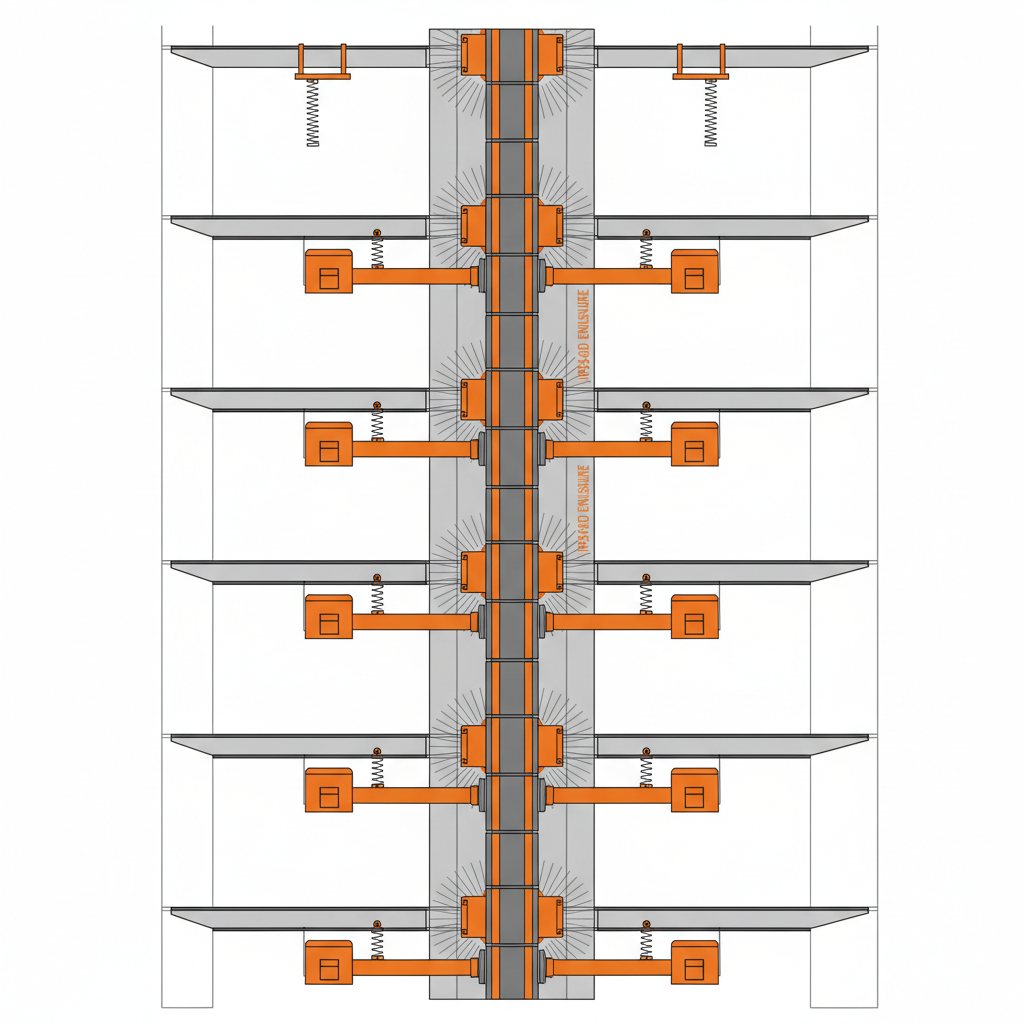
Installing air insulated busbar trunking in high-rise buildings introduces constraints that do not exist in horizontal industrial runs — vertical thermal expansion, floor penetration fire-stopping, and shaft width minimums must all be resolved before the first section is lifted into position.

The air insulated bus duct installation requirements for high rise buildings begin at the shaft planning stage, long before any hardware arrives on site.

Shaft space planning is the first checkpoint. Air insulated enclosures are wider than compact equivalents at the same ampacity. A 2000A air insulated unit typically requires 200–250mm more horizontal clearance than a compact equivalent at the same rating. MEP teams who finalize shaft dimensions against compact specifications and then switch to air insulated mid-project create problems that are expensive to resolve after concrete is poured.

Vertical thermal expansion joints are non-negotiable. Rising mains in tall buildings experience significant thermal cycling between loaded and unloaded states. Expansion joints must be specified at regular intervals — typically every 20 to 30 meters of vertical run — to prevent cumulative mechanical stress from concentrating at bolted joints. Omitting these is one of the most common specification errors we see on submitted project drawings.

Spring-loaded hanger support systems replace the rigid bracket approach used in horizontal installations. Vertical sections must use spring hangers that allow controlled movement under thermal expansion while maintaining alignment. Support spacing and load calculations differ substantially from horizontal runs, and the rigging sequence during installation must account for the progressive weight loading as sections are stacked upward.

Floor penetration fire-stopping is a compliance checkpoint that delays projects when it is left to the installation phase rather than resolved in design. Each floor penetration requires fire-rated sealing materials matched to the building's fire compartmentation rating. This is not an afterthought — it requires coordination between the busbar trunking supplier, the fire-stopping material supplier, and the building authority's approval process.

Joint alignment precision is more demanding in vertical runs than horizontal ones. In horizontal installations, gravity helps conductors settle into alignment. In vertical runs, rigging accuracy is the only control. Misalignment at joints — even a few millimeters — is the most common cause of insulation stress and premature failure in high-rise air insulated installations. ZHERUTONG provides pre-project shaft dimension templates and installation checklists to MEP contractors specifically to address this, drawing from our experience with multi-floor commercial and mixed-use projects across Southeast Asia and the Middle East.

For sections passing through areas with elevated humidity — plant rooms, basement levels, or external wall adjacencies — specifying IP54 or higher is a practical recommendation rather than an optional upgrade.

How Do the Total Cost Structures Actually Compare?

The common assumption that compact busbar trunking always costs more upfront is only partly true — at current ratings below 2000A, compact often costs less over a three-to-five year horizon when installation labor, energy losses, and maintenance are factored in together.

Consider a worked example: a 1600A, 60-meter trunk run in a logistics warehouse. Air insulated will likely carry a lower unit material cost. But compact sections at this rating are lighter, narrower, and faster to join — reducing crane time and labor hours by an estimated 20–30% on a typical warehouse ceiling installation. Over a five-year operating period at 70% load factor, the lower inductive reactance of the compact system generates measurable energy savings that begin to offset any initial price premium within two to three years. This is an approximate engineering estimate, not a guaranteed figure — it depends on local energy tariffs and actual load profiles — but the directional argument is consistent across multiple project types we have supplied.

The cost picture reverses above 2500A. At these ratings, air insulated material costs are generally lower, installation complexity is comparable, and the thermal management advantages of the air gap mean the system operates reliably without additional engineering interventions. For a single transformer feeder run at 4000A, the lifecycle cost difference between the two types narrows considerably in air insulated's favor.

Maintenance cost also factors differently depending on environment. Air insulated allows visual conductor inspection and localized repair without specialized tooling. Compact systems require more diagnostic sophistication — insulation resistance testing, thermal imaging — but in clean environments they generally have fewer failure points over time. For facilities with trained maintenance teams, air insulated's accessibility is a real operational advantage. For facilities that run lean on maintenance resources, compact's lower intervention frequency may be preferable.

How Should You Make the Final Selection Decision?

The selection decision reduces to four variables: rated current, available installation space, site environment conditions, and total project budget horizon — and in most real projects, one of these four will dominate and effectively make the choice for you.

The table below captures the decision logic in a format you can reference directly in a project meeting or specification document:

Decision Variable

Choose Air Insulated

Choose Compact

Either Viable

Rated Current

Above 3200A

Below 1600A

1600A–3200A

Available Shaft/Ceiling Space

Large industrial space, no constraints

Tight shaft, space-critical

Moderate space with planning

Environment (Humidity/Dust)

Dry, clean, controlled

Humid, coastal, tropical

Controlled indoor, moderate humidity

Budget Priority

Lower upfront cost on high-current runs

Lower lifecycle cost on mid-range runs

Balanced budget, flexible timeline

Run Length

Short feeder runs under 20m

Long distribution runs over 60m

20m–60m runs

Neither system is universally superior. The right answer is always project-specific, and the four variables above rarely all point in the same direction — which is exactly why this decision keeps coming up in project meetings.

ZHERUTONG's engineering team regularly assists with specification decisions for OEM clients, MEP contractors, and procurement specialists working on complex multi-floor or multi-zone projects. Custom configurations — non-standard ampacity ratings, specific IP grades, hybrid conductor materials, or enclosure dimensions outside standard catalog parameters — are available when the project requires them.

---

What Are the Most Common Questions About This Selection?

Is air insulated busbar trunking suitable for outdoor installation?

Standard air insulated busbar trunking is designed for indoor use; outdoor installation requires a minimum IP55-rated enclosure with additional weatherproofing measures, and ZHERUTONG can configure the RT-CKX8 accordingly for covered outdoor environments.

Uncovered outdoor exposure introduces UV degradation, condensation cycling, and contamination risks that standard IP42 or IP54 configurations are not designed to handle long-term. If the installation is under a permanent canopy or within a weatherproof enclosure structure, IP55-rated air insulated systems are a practical option — but this should be confirmed with the manufacturer before specification.

Can compact busbar trunking handle the same ampacity as air insulated?

Compact busbar trunking is available up to approximately 4000A in standard configurations, while air insulated systems extend reliably to 6300A — for projects above 4000A, air insulated is typically the more practical and cost-effective path.

Above 4000A, the thermal management demands of compact construction require increasingly complex engineering solutions. Air insulated systems at these ratings benefit from natural convection physics that make high-ampacity operation straightforward by comparison.

How does humidity affect the choice between the two types?

High ambient humidity is a stronger concern for air insulated systems because moisture in the air gap can degrade insulation resistance over time; compact systems, with their sealed solid insulation, are inherently more resistant to humid environments and are generally preferred for coastal or tropical installations.

This is a real-world factor that affects projects in Southeast Asia, the Middle East, and coastal regions globally. If the installation environment has consistent relative humidity above 80%, or if the site is within a few kilometers of the ocean, compact busbar trunking is the lower-risk choice regardless of other variables.

What is the typical lead time difference between the two types from ZHERUTONG?

Both types are manufactured to project-specific dimensions at ZHERUTONG, with standard lead times of 3–5 weeks for air insulated and 4–6 weeks for compact systems depending on ampacity and run length; custom configurations or large-volume orders should allow additional lead time.

Both types require project-specific production runs — standard catalog sections exist, but most installations require custom lengths, specific tap-off positions, and configured end units. Submitting complete project drawings and load schedules at the time of inquiry allows us to confirm lead time accurately rather than estimating from a general range.

Do both types comply with IEC standards for low-voltage power distribution?

Yes — both air insulated and compact busbar trunking systems from ZHERUTONG are designed and tested in accordance with IEC 61439-6, covering rated insulation voltage up to 1000V and current ratings across the full product range.

IEC 61439-6 (which superseded IEC 60439-2) is the applicable standard for busbar trunking systems in low-voltage power distribution. Compliance documentation, test reports, and product certifications are available on request for both system types.

---

This decision sits inside a larger project specification where shaft drawings, transformer ratings, budget constraints, and installation timelines all intersect simultaneously. There is rarely a clean answer that ignores all of those variables — which is why the most useful thing we can offer is not a product recommendation, but a technical conversation grounded in your actual project parameters.

If you are currently working through a specification and need help confirming which system fits your current rating, shaft dimensions, or installation environment, send your project requirements, drawings, or load schedule directly to our engineering team. Every inquiry is reviewed with the same technical attention we apply to our own production specifications.

📧 rtdq@rtbusway.com

Whether you need a standard configuration, a custom ampacity range, or a sample unit for client approval, we are ready to support your project from specification through to delivery.

ရှေ့စာမျက်နှာ
နောက်စာမျက်နှာ

CONTACT US

If you have any queries, get in touch today! Don't hesitate. We try to take the extra step for our customer satisfaction.
First Name *
Company Name *
Email *
Last Name
Country
Message *
Leave a message
First Name *
Company Name *
Email *
Last Name
Country
Message *